·6 min read
When to Prune Crepe Myrtles in Maryland — Month-by-Month Guide
Crepe myrtles tolerate Maryland winters but bloom on new wood. Prune at the wrong time and you lose the whole summer's flowers. Here's the right month, the right cuts, and how to fix a tree that's been "crepe-murdered.
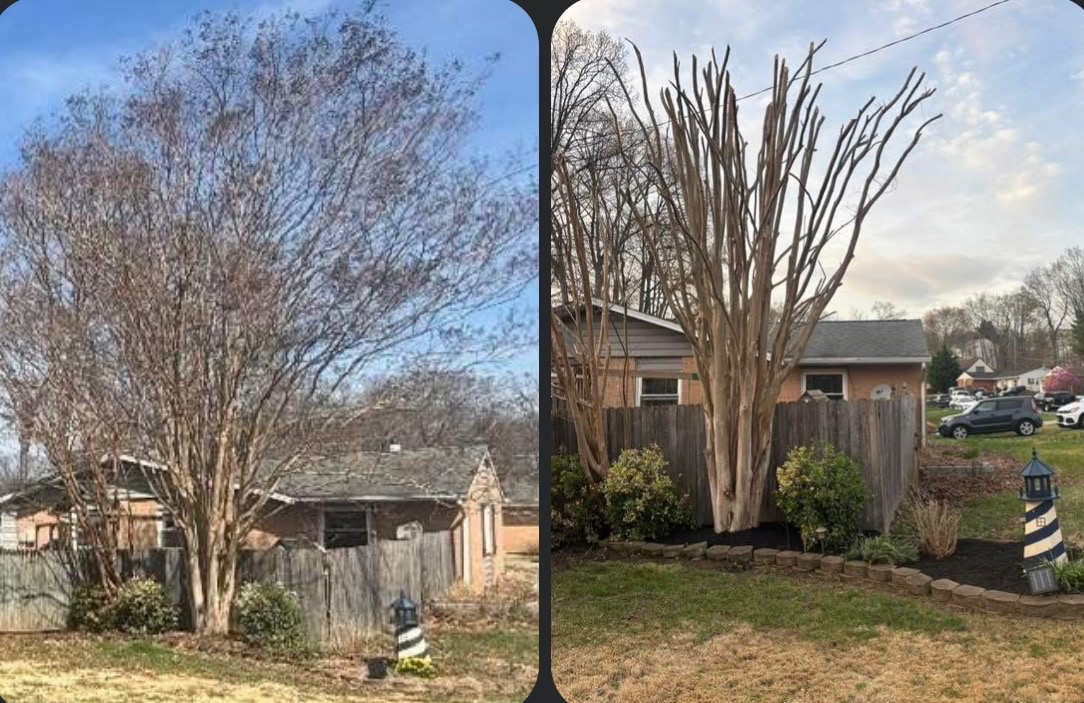
Crepe myrtles (often spelled "crape" interchangeably) are one of the most common ornamental trees in Maryland yards. They tolerate our zone 7a winters, hit full bloom in July when little else is flowering, and tolerate everything from clay soil to coastal salt.
But they're also the most-mispruned tree in our service area by a wide margin. Pruning at the wrong month — or pruning the wrong way — costs you a full season of flowers and damages the tree's structure for years.
Here's the right rhythm, by month.
The big rule: bloom on new wood
Crepe myrtles flower on growth that develops this year, on top of last year's wood. That means:
- Pruning stimulates new growth that produces the year's blooms
- Pruning late (after new growth has started) cuts off the buds
- Not pruning at all means the tree blooms anyway, just smaller and on more branches
This is the opposite of dogwoods, magnolias, and other spring-blooming trees that flower on last year's wood. Those need to be pruned right after they bloom; crepe myrtles need to be pruned before they leaf out.
Month-by-month
January
Status: Tree is fully dormant. Last year's seed heads still on the branches. Bark exfoliating in some varieties.
To do: Wait. January is too early in Maryland. Pruning now exposes fresh cuts to deep cold, which can dieback into the cambium. Save your work for late February or early March.
OK to do now: Plan the cuts. Walk around the tree and visually identify branches that:
- Cross or rub other branches
- Grow toward the center of the canopy
- Are smaller than your thumb at the base
Those are the candidates for removal in February.
Late February to mid-March (the prime window)
This is THE month. Fully dormant, but past the deepest freezes. Cuts heal cleanly as the tree wakes up. New buds haven't broken yet, so you can still see the structure.
The right cuts:
- Remove dead wood first. Anything brittle, hollow, or breaks easily.
- Remove crossing branches. Two branches rubbing each other will both wear and create entry points for disease.
- Remove suckers from the base. Crepe myrtles produce vigorous shoots from the trunk. Pull or cut these flush.
- Selective tip pruning. Cut tips of last year's growth back by 1/3 to encourage branching. Make cuts just above an outward-facing bud.
- Remove seed heads if you want. Optional aesthetic — leaves a cleaner silhouette, but the tree blooms fine either way.
That's it. Five cuts on a typical residential tree. Should take 15 minutes.
April
Status: Buds break, first leaves emerge, then first blooms develop on the year's new growth.
To do: Hands off. Pruning now removes the developing flower buds. If you forgot February, skip pruning entirely this year — the tree will still bloom. You'll just have to live with last year's structural issues until next February.
May–August
Status: Active bloom and growth.
To do: Hands off again, with one exception:
- Deadhead spent flower clusters to encourage a second smaller bloom flush. Snip off browned flower heads as they finish — the tree will often re-bloom 4–6 weeks later.
Real structural pruning still waits for next February.
September–October
Status: Late blooms wrapping up, leaves starting to color (yellow, orange, red on some varieties).
To do: Avoid cutting. Late-season cuts force a flush of tender growth that gets killed by the first frost, which damages the cambium. Just rake the leaves and watch the seed pods form.
November–December
Status: Dormancy approaching, leaves drop. Seed pods left on bare branches (the "rusty bottle brushes" look).
To do: Plan for February. You can mark branches with colored ribbon now while structure is fully visible. But don't cut yet — late cuts in November can still see warm enough days to encourage new growth that then dies in December cold snaps.
"Crepe murder" — and how to fix it
The most common pruning mistake in Maryland is topping — cutting the entire canopy back to a fixed height every year, leaving stubs. Sometimes called "pollarding" when done correctly, but routinely done wrong on residential properties as "crepe murder."
What it does to the tree:
- Suckers explode at the cut points — 5+ shoots from each stub
- Branch attachment is weak at sucker bases, so they break in storms
- Tree structure deteriorates over years, leaving a knotted-knuckle look
- Bloom size shrinks as the tree puts energy into supporting the dense, weakly-attached growth
If you've inherited a crepe-murdered tree, you can rehabilitate it over 3 years:
Year 1: Identify 3–5 strong leader shoots from each old stub. Remove the rest. The tree will look thin but it's the right move.
Year 2: Continue selecting and reducing. Start tip-pruning the leaders to develop a real branching structure.
Year 3: Tree should look like a tree again — open canopy, distinct main branches, suckers controlled.
If the tree has been crepe-murdered for 5+ years, full rehabilitation may not be possible. Often the right answer is to remove the existing tree (or cut to ground and let one fresh leader establish) and replant a new specimen.
Pollarding (the right kind of heavy prune)
Confusingly, real pollarding is a legitimate technique that looks similar to crepe murder but is done correctly:
- Cuts are made at the same point each year (a "pollard knob"), so the tree forms permanent knuckles
- Done late winter only
- Results in dense, controlled canopy at a fixed height
- Common on European street trees and some heritage gardens
Pollarding works on crepe myrtles when you want a dense, controlled, low canopy — say, in front of a window or under a power line. It's not what most homeowners want, and it's not what crepe murder is. Crepe murder is pollarding done badly: random heights, bad cut placement, no consistent knob structure.
We pollard crepe myrtles by request when the homeowner specifically wants the look and the size control. We don't do random topping.
How tall a crepe myrtle should you have?
Most residential varieties grow 15–25 feet at maturity. Common ones in our area:
- Natchez (white blooms, exfoliating cinnamon bark): 25–30 ft
- Tuscarora (coral-pink blooms): 18–22 ft
- Sioux (pink, dark fall color): 18–22 ft
- Acoma (white, weeping form): 8–12 ft
- Pocomoke (pink, dwarf): 3–5 ft
If your tree is too big for its spot, it's the wrong variety, not pruning that needs to fix it. Replacement is the right answer when there's a 5-foot gap and a 25-foot tree. We'll usually advise that honestly rather than try to keep cutting it back.
When to call us
We do crepe myrtle pruning February through mid-March across Harford and Baltimore counties. A typical residential job is 20–45 minutes per tree. We charge per-job, not per-hour, so you know the price up front.
We also do:
- Real pollarding if you want the formal pollard-knob look
- Crepe murder rehabilitation as a 3-year project
- Deadwood and storm cleanup any time of year
- Removal and replanting when the tree is the wrong size for the spot
Cliff notes for the year: Late February to mid-March, light selective cuts. Skip the rest of the year. Don't top. If you want, deadhead spent blooms in summer for a second flush. That's it. The tree handles the rest.
Walking the property is free. We'll tell you exactly what each crepe myrtle needs and what it doesn't — half the trees we look at need less pruning than people are doing.
Related: Tree Trimming & Pruning
Skip the DIY. We'll handle the tree trimming & pruning.
Free estimates, same-week start, work you can point at. Serving Harford County, Baltimore County & Baltimore City.